
Buying trimmer line often looks simple until you see the options.
2 mm twisted. 2.7 mm round. 2.7 mm square. 3 mm round. 3 mm square.
They may all look like nylon line, but the shape and diameter can change how the line behaves during cutting.
So, when it comes to round vs square vs twisted trimmer line, which one should you choose?
The answer depends less on which profile is “best” and more on what you are cutting, what machine you are using, and what diameter the machine is designed to handle.
What Does Trimmer Line Profile Mean?
The profile is simply the shape of the line when you look at its cross-section.
The three common options are:
- Round
- Square
- Twisted
That small difference in shape changes how the line meets the vegetation.
But there is one thing to settle first: diameter.
A thicker line is not automatically a better line. Your brush cutter or trimmer has a recommended line diameter, and using a line that is too large can increase the load on the machine. Oregon also recommends checking the equipment manual before using a larger diameter.
Once you have the right diameter, the profile becomes much easier to choose.
Round Trimmer Line: The Everyday Choice
Round trimmer line is probably the profile most people come across first.
Its smooth shape makes it a practical option for general trimming and routine vegetation maintenance. Oregon describes round Gatorline as its most popular trimmer-line shape and says it is suitable for a range of applications.
At Omni Green Solutions, the Oregon range includes:
- 22-305 – 2.7 mm Gatorline Magnum Round
- 22-505 – 2.7 mm Gatorline Magnum Round
- 69-369 – 3.0 mm Round Trimmer Line
The 2.7 mm options are available in different pack sizes, while the 3.0 mm option comes in a 30-metre hanger pack.
For someone doing regular grass trimming, garden maintenance or general clearing, round line is a sensible place to start.
Think of round line as the practical all-rounder.
Square Trimmer Line: When the Edges Matter
Now look at the same diameter in a different shape.
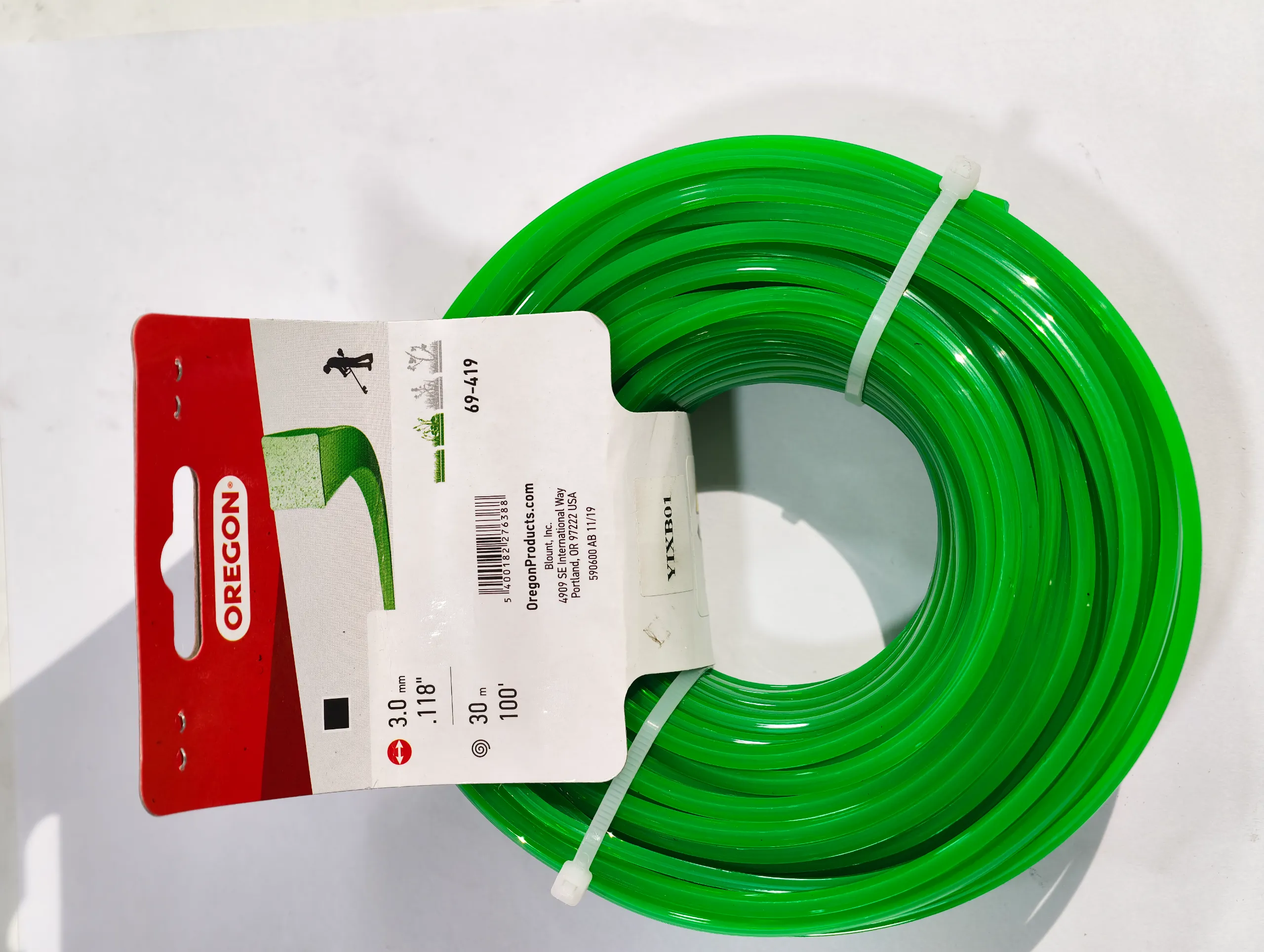
Square trimmer line has four edges. As the line rotates, those edges give it a different cutting action from a round profile. Oregon describes its square Gatorline as slicing through vegetation with a clean, even pass.
Omni Green Solutions has:
- 22-405 – 2.7 mm Gatorline Magnum Square
- 22-005 – 2.7 mm Gatorline Magnum Square
- 69-419 – 3.0 mm Square Trimmer Line
This makes square line worth considering when the job involves thicker grass or tougher weeds, provided the machine is rated for the selected diameter.
There is a trade-off, too. A more aggressive cutting profile isn’t necessarily what you want when most of your trimming happens around hard surfaces.
So don’t choose square simply because it sounds stronger.
Choose it because its cutting profile suits the work.
Twisted Trimmer Line: Why Use a Spiral Shape?
Twisted line looks different from both round and square line.
Instead of a smooth circular surface or defined corners, the line has a spiral profile.
Omni’s range includes the 20-118 2 mm Super Twist Platinum Gator Line, supplied in a 1 lb donut containing 126 metres.
Oregon says its twisted Gatorline profile produces less drag and fewer decibels than other shapes, while also providing a straight cut.
That makes twisted line an interesting option for users who want a balance between cutting performance and a less harsh operating sound.
But again, the machine comes first. A 2 mm line may be appropriate for one trimmer and completely unsuitable for another.
Round vs Square vs Twisted: Which One Is Right?
Here’s the simple way to look at it:
| Trimmer Line | Profile | Omni Options | Consider it for |
| Round | Smooth | 2.7 mm, 3.0 mm | General trimming and routine maintenance |
| Square | Four edges | 2.7 mm, 3.0 mm | Thicker grass and tougher weeds |
| Twisted | Spiral | 2.0 mm | Light trimming and users looking for a quieter-running profile |
These aren’t rigid rules. Your machine’s specifications still take priority.
And that’s an important point when choosing the best trimmer line for a brush cutter.
Don’t Choose Trimmer Line by Shape Alone
Imagine two people buying a 3 mm trimmer line.
One is clearing ordinary grass around a property.
The other is cutting dense weeds for hours with a professional brush cutter.
They may both need 3 mm line, but the ideal profile and application can be different.
Before buying, check:
1. What are you cutting?
Grass, weeds and heavier vegetation place different demands on the line.
2. What diameter does your machine accept?
Always follow the manufacturer’s recommendation.
3. What profile suits the job?
Round, square and twisted lines have different characteristics.
4. How much line do you need?
Omni’s Oregon range includes small hanger packs as well as 1 lb and 5 lb options, making the choice relevant for both occasional users and regular operators.
So, Round, Square or Twisted?
There isn’t one trimmer line that wins every job.
Round is a practical choice for general-purpose trimming.
Square offers defined cutting edges and can be useful for tougher vegetation.
Twisted gives you a different balance of cutting behaviour, drag and operating sound.
The smarter approach is to choose the right profile and diameter for your machine and your work.
After all, the best trimmer line isn’t necessarily the thickest one or the most aggressive one.
It’s the one that matches the job.
Explore Oregon Trimmer Lines from Omni Green Solutions
Omni Green Solutions offers Oregon trimmer line in 2.0 mm, 2.7 mm and 3.0 mm options, across round, square and twisted profiles.
Choose the profile. Match the diameter. Get to work.